Showing posts with label terminology. Show all posts

Wednesday, January 2, 2013

Grandma's Pistol (Part 2)

Thanks so much to everyone who sent notes here and on Facebook.  I've had fun learning about this little pistol.

To summarize what I've learned.  This basic style is referred to as a velodog pistol.  The name is a combination of the words velocipede (old term for bicycle) and dog.  They were used to scare off dogs that tried to chase and attack bicyclists.  They were designed to fit comfortably in a gentleman's pocket while riding a bike, thus the folding trigger and enclosed hammer.

However, a true velodog revolver had an elongated cylinder, chambered for 5.5mm center fire rounds.  My grandmother's gun does not have this elongation.  thus it is more likely a later revolver in the same style, but intended for personal defense, not dogs.

Auguste Francotte was based in Liege, and produced firearms beginning in 1810 and was most active in the late 1800s and early 1900s. The company produced no less that 150 revolver styles by the end of the 1800s.

Click to see full size. 


Thanks again to all those who helped in my hunting.  It's been a fun adventure!

Enhanced by Zemanta

Wednesday, January 18, 2012

Grains

In my continuing quest to get all the ittle thing I'm learning put up here too...

Today, I talk about grains.  As always, I'm so far from being an expert it's not even funny.  But writing these things down helps me assemble them in my brain and might help other new gunnies reading this. 

So, grains still confuses me after lots of reading.  I think this is because the term is used to refer to BOTH the weight of the projectile (bullet) AND the weight of the powder in the round.

A grain is a unit of measurement, with 437.5 grains equaling one ounce or 64.79891 milligrams.  (This where I start bemoaning our use of the imperial system rather than the much easier to understand metric system.)


History of the term grain is a bit ambiguous, but seems to come from England:


"where it referred to the weight of a barleycorn. This made the English grain larger than the corresponding grain units of France and other nations of the Continent, because those units were based on the weight of the smaller wheat grain."


When your ammo box indicates grains, it is only the weight of the bullet, not the powder load.  Different brands will use different amounts of powder, but this may not be readily available on the box.  Hence why different brands of ammunition with the same bullet weight (grains) shoot differently.


So, how does bullet weight affect my shooting?

Light bullets move faster (given equal powder) and have a flatter trajectory.  This should make them easier to aim, especially at close range.  Because they are lighter, they will have less impact force at longer distances.

Heavier bullets will have more resistance and thus more arc to their trajectory, thus needing more compensation in aim point at longer distances.  However, thir weight allows them to retain speed and power at longer distances.

(For those archers out there, this is similar to differences seen with different arrow weights, lengths, and points)


As to the grains of powder, more is not always better.  Increasing the powder results in more force applied to the bullet upon firing.  This results in more velocity to the bullet, but can also cause more recoil.  Most powder loads will be similar across brands from what I understand.  The exception is in +P loads that will have havier powder loads.


That's the basics.  I tried reading more details, but I ended up more confused than when I started.  Maybe in the future...  I know lots of you out there are more familiar with this than I.  So, please correct me if I'm off somewhere or missing some crucial point in this explanation of grains.

Friday, January 6, 2012

My first pet peeve...

Ok, so I have a lot of pet peeves, just ask my husband.  But this is neither the time or place to go into my mania about shower curtains.  I have however, found my first firearms related peeve. 


I'm not really sure that's something to celebrate, but who cares.  Any excuse for a good party right?  Lets break out the noisemakers and paper hats.  Whith this celebration comes yet another terminology lesson.


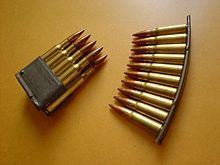
These are clips:


This is not:


A clip is an ammunition retaining device.  It is used to hold rounds for insertion into a magazine or cylinder.  A magazine loads the round into the chamber of the firearm.  Your pistol does not use a clip.  It uses a magazine. 

Minute man review has also written about this terminology difference.  And does a much better job than I at explaining the difference.

In all honesty, it's not a big thing (what pet peeve ever is?), but I think th scientist in me gets twitchy with imprecision terminology.  You wouldn't want to confuse the many types of pipettes or get the wrong reagent when mixing a solution right? 

Although, now that I tihnk about it, missusing vocabulary bothers me in all aspects of life.  Perhaps that's why this video is one of my favorites.  No, not firearm related, but humorous none the less.


*pics from wiki commons, no clips in my house....


Monday, December 5, 2011

Single, double, or safe?

No relation to baseball, promise!  Single, double, and safe are all types of actions on semiautomatic pistols.  The action refers to what happens when you pull the trigger.


Tuesday, November 15, 2011

Ammunition Anatomy

I really wanted to call this Anatomy of a Bullet, but that's technically incorrect, and I'll explain why below.

As I'm shooting, I tend to think of questions, rather than keeping my mind on what I'm doing.  Maybe that's why I keep missing? Anyway, I figure the best way to get these questions out of my head is to answer them.  Today, we are going to look at the anatomy of ammunition!  I'm specifically looking at centerfire rounds, though the principles are the same for rimfire and shotgun shells.

There are four basic parts to each round.


1) Casing
From Starline Brass
Cartridge cases are generally brass.They contain the powder and primer and hold the projectile in close proximity to these explosives.  The crimp is the part of the cases that crimps or curves inward to hold onto the projectile.  The head (closed end) of a casing seals the back of the chamber to force the gasses forward and expel the projectile.  The base of the casing has a rim that is gripped by the extractor to remove the empty casing or to prevent the round from moving to far into the chamber of a revolver.

2) Projectile

This is the bullet, and why I couldn't title this post anatomy of a bullet, as that would be over fairly quickly.  I'll have to get to ballistics eventually though!  Most bullets are made of lead and some have copper or other jackets. In general, bullets are designed to expand on impact.  There are frangible (breakable) and other types of specialty rounds for unique uses.

3) Powder
Powder is the general term for the compound that produce gasses to push the projectile out of the barrel.  Historically this was black powder, which is a combination of charcoal, sulfur and saltpeter.  Most modern powders are 'smokeless' compounds of nitrocellulose and/or nitroglycerin

4) Primer
This is the collective term for the chemical primer compound, cup and anvil which is located int he head of the case.   When the primer is struck, it ignites the priming compound.  The flame travels through the flash hole to ignite the powder. 


How does it all work together?
  • The firing pin impacts the primer
  • Ignition of the priming compound
  • Flame moves through the flash hole of the casing
  • Ignition of the powder
  • Burning powder creates large amounts of gas that expand the case to seal the chamber 
  • Gasses push the bullet down the barrel 


If you'd rather see this information in video form, check this one out.

Thursday, November 10, 2011

Rimfire v. Centerfire

Terminology Lesson 2: Rimfire versus Centerfire

These terms refer to the way that the cartridge of the round.

In centerfire, the firing pin hits the primer, contained in a firing cap, in the center of the base of the catridge.  If you look at the casing after firing centerfire, you see a round divot in the center, as below.  Centerfire ammunition is the most common style for military and law enforcement.  Centerfire cases are made of thicker metal than rimfire, which allows them to withstand higher pressures, and thus can be fired at higher velocities.  In addition, most shotgun shells are centerfire, though they typically use a  plastic casing.  Centerfired casings can be reloaded (another topic for later, replacing the primer, gunpowder, and projectile.
From a 9mm Beretta 92FS


In rimfire, the firing pin strikes the rim of the cartridge base.  The rim acts as a percussion cap for the cartridge.  The firing pin leaves a notch type depression on the edge of the casing, as below.  Rimfire casings must be made out of very thin material to allow for the necessary deformation by the firing pin to ignite the primer.  This deformation means that the cartridge cannot be reloaded.  However, this thinner casing allows for rimfire ammunition to be much less expensive than centerfire.  Almost all modern rimfire guns are .22 caliber or smaller, though historically rimfire was used in firearms up to .44 caliber. 
From a .22 match rifle


Extra bit:
Semi-automatic vs. revolver ammunition.  Semi-automatic casings have an inset rim (but are generally referred to as rimless) that allows the extractor to remove the casing after firing.  Revolver rounds have a rim at the base to prevent the round from moving too far into the cylinder, which would prevent the firing pin from reaching the base and firing the round.  I'm on the hunt for a good picture of the difference, we don't have any revolvers in the house...


As always, I hope you learned something.  I know I did in writing this! What do you shoot?  Everything in our house is centerfire, but I got to play with a friend's .22 match rifles and scoped target pistol this weekend.  Tons of fun!

Do you have a terminology (or other) questions?  I'd love to write about anything y'all think is important.

Monday, October 31, 2011

Stacks?

As I read more about handguns, I have to stop every now and then and look up new terms or ask my husband what I'm sure he feels are silly questions.  I figured I'd start using these moments to write quick little terminology lessons for everyone else.

Lesson 1: Single stack vs. double stack.


I found this handy diagram on the Code 3 Tactical Supply site.
I figured out rather quickly this had to do with the magazines and how the bullets were loaded into them.  Single stack is exactly what it sounds like, the bullets are in a single file line, one neatly on top of the other.  Double stack means that the bullets zig-zag in the magazine.  This allows for a greater amount of bullets in the same vertical space, but also results in a  wider magazine.

If you are a girl with super small hands, you will likely find a single stack gun more comfortable.  Though you have to trade capacity for small grip size.  If you aren't comfortable with the larger grip, and it throws off you aim, the extra rounds in a double stack aren't going to be much use.